Andy Warhol’s pneumonia
The Andy Warhol DiariesAndy Warhol’s pneumonia in June 1981 interrupted his plans to travel for work and exposed the limits of his confidence that he could walk through any difficulty. A fever, a persistent infection on chest X-rays, and his doctor’s orders kept him home; during the same days, an apparent rupture with Jon Gould deepened his depression. The diary follows both developments closely, from Warhol’s reluctance to take his health seriously to the confirmation that the pneumonia had cleared.
Warning Signs and Medical Uncertainty
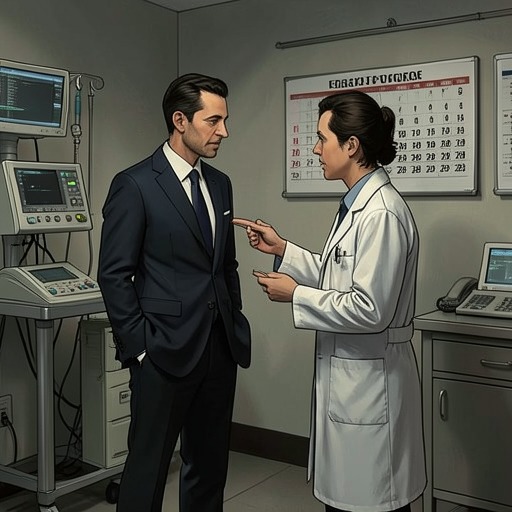
On June 9, Warhol called Doc Cox’s office seeking a B-12 shot before leaving for a show in Seattle. Rosemary, at the office, was instead preparing to give him a pneumonia shot, which had been recommended after he reported losing weight. He had not thought the preventive shot necessary and had not taken the advice seriously. With a temperature of 100, however, Rosemary became concerned that he might already have pneumonia. She told him to go straight home, get into bed, and remain there for two days if he wanted to make the trip. A chest X-ray followed, turning what Warhol had treated as a precaution into a possible reason to cancel his plans.
The diagnosis was not immediately settled. Warhol was instructed to have another chest X-ray on Thursday, and the infection was still present when he returned to Doc Cox on June 11. The diary does not describe a dramatic crisis: Warhol said he felt okay and, initially, had no fever. But the medical evidence and the doctor’s restrictions overruled his own sense that he could carry on as usual. He wrote that his theory of being able to walk through everything was not working.
Work Interrupted and Recovery
The illness threatened a specific professional commitment. Warhol was due to travel to Seattle and California, and Fred Hughes had to prepare papers so that Warhol could send out his IRS materials while he was ill. On June 11, Doc Cox said the infection remained and told him not to travel. Warhol recorded that he was depressed the whole day. The decision left his work plans uncertain as well as confining him to recovery at home.
By June 12, the pneumonia was on the mend. His doctor allowed him to go out, but told him to be careful. Warhol supplied his own explanation for the illness: he was sure he had caught pneumonia from a cold daiquiri. He also wondered whether, without the doctor’s visit, he would have recovered without ever knowing he had it. A vaporizer stood in his room. The entry preserves both the practical details of being sick and Warhol’s speculation about whether medical attention had helped or merely named an illness that might otherwise have passed unnoticed.
The follow-up came four days later. On June 16, Warhol went to an early appointment with Doc Cox, feeling well and reporting a normal temperature. The doctor said the pneumonia had completely cleared. The diary thus records a defined medical course: warning and fever, an X-ray-confirmed infection, cancelled travel, cautious improvement, and a final declaration of recovery.
Illness and Emotional Vulnerability
The pneumonia coincided with distress over Jon Gould. When Gould returned to town, Warhol understood that he had made weekend plans because he thought Warhol would be away. Gould said he would call, but did not. Warhol interpreted this as evidence that their relationship had fallen apart, said he needed to pull himself together and find a new philosophy, and cried himself to sleep. Watching Urban Cowboy, in which John Travolta danced beautifully, made him think further about Gould because the film was a Paramount production. Physical confinement, disappointment, and reminders of Gould converged in the same short stretch of diary entries, without the text suggesting that one caused the other.
The next day, still depressed, Warhol felt he would explode if he did not get out of the house and wanted to go to work. That impulse contrasts with the doctor’s insistence on rest and with the earlier effort to carry on despite symptoms. Once the pneumonia had cleared, Warhol put his outlook into a compact declaration: “Life is not worth living if you’re not healthy, and health is wealth.” In these entries, health is not an abstract concern; it determines whether he can travel, work, leave home, or maintain his usual sense of control.
The Diary’s Wider Record of Bodily Fear
The 1981 episode belongs to a diary in which health worries recur, though not every illness is treated with the same intensity. In June 1977, Warhol underwent a neck biopsy while fearing that the result might mean his days were numbered. When the doctor gave him good news, he went to church to give thanks, despite the swelling and pain that followed the procedure. Pat Hackett later observed that, in retrospect, Warhol scarcely mentioned the health problems that truly frightened him; she identified that earlier neck lump as one such episode. The account offers a useful contrast, not proof that Warhol concealed his pneumonia: in 1981 he recorded the fever, tests, travel restrictions, and recovery in detail.
Pat Hackett’s method helps explain that everyday precision. She and Warhol spoke by phone on weekday mornings, and she took notes as he recounted the previous day, including details he wanted added to the Diary. The illness entries retain that routine’s attention to practical particulars—the appointment, the X-rays, the travel plans, and the doctor’s changing instructions—while also preserving abrupt changes in mood. Together, these details make the pneumonia more than a passing medical diagnosis: it is a brief interruption in which bodily limits become unmistakable, even as work and emotional life continue to press in.